The hidden cost of branch downtime
When a site goes dark, the repair invoice is the smallest line on the bill. What a closed or degraded branch actually costs a multi-site enterprise in India — and why prevention is a finance decision, not a facilities one.
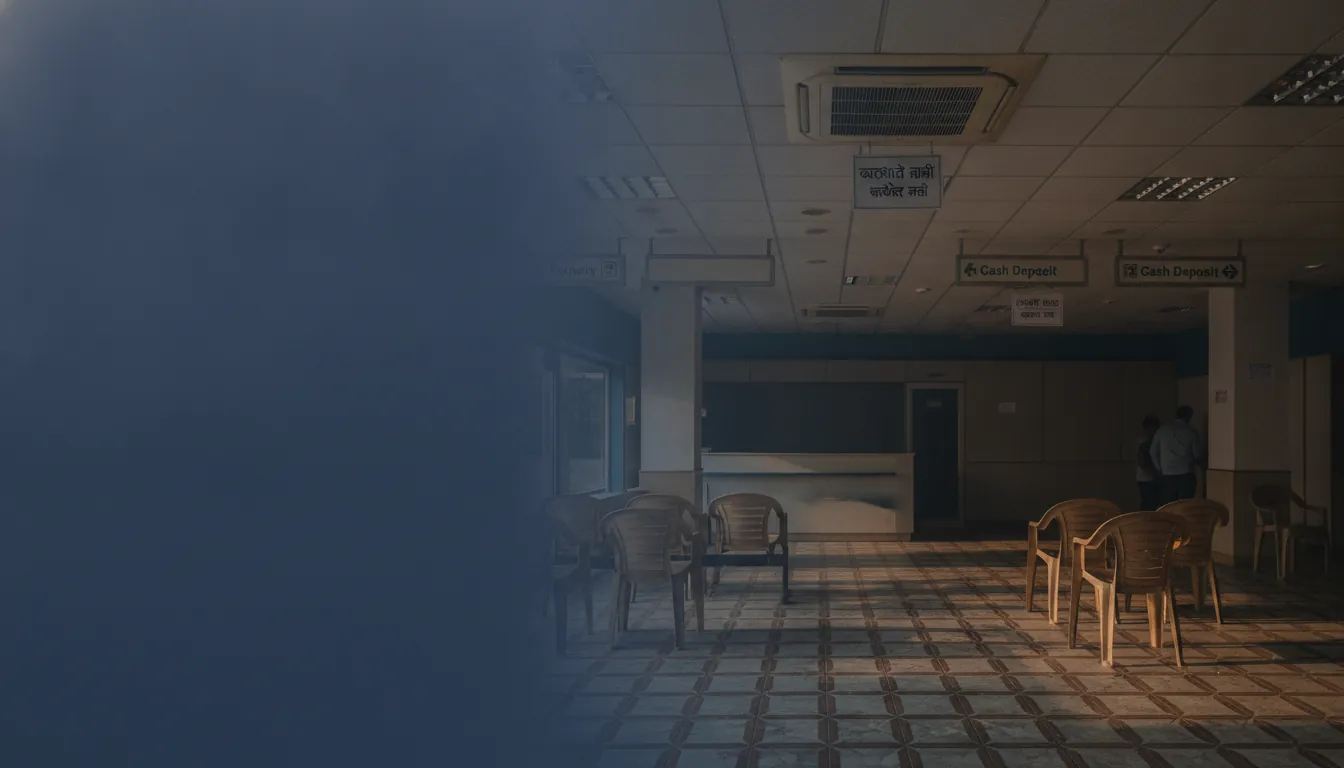
Picture a May afternoon in Delhi NCR: an air-conditioning compressor fails in a bank branch. The repair, when it finally happens, is billed at a few thousand rupees. Everything that happens between the failure and the repair is billed to nobody — and costs far more. The branch runs at 44 degrees of discomfort for four days. Customers leave. Staff improvise. A regional manager makes eleven phone calls to three vendors, two of whom quote without visiting and one of whom arrives without parts.
India's bank-branch network alone is estimated at more than one lakh outlets (benchmark); most multi-site enterprises run their estates on the same operating model as a single shop — a local vendor per trade per city, coordinated over phone calls and WhatsApp, with no SLA anyone can see. A single break-fix visit is typically billed at ₹1,500–3,000 in the fragmented market (benchmark). The visit is not the expensive part.
The compressor failed in an hour. The coordination failed for a week.
The invoice records the repair. It never records the downtime.
Downtime is a coordination problem
The failure chain is organisational, not mechanical. No asset baseline: nobody at HQ knows the compressor's age, capacity or service history; every failure is investigated from zero, by phone.
No triage: the branch escalates by seniority, not severity — the loudest site gets served first, not the one bleeding most. No benchmarked rate: every emergency quote is a first quote; urgency prices the job, and nobody at head office can say what the same repair cost last quarter, two cities away.
No evidence trail: the fix closes as a verbal 'done' — no photo, no date, no responsible party. When the inspector asks, the estate has opinions, not records. Reactive-only estates pay for fragmentation twice — once in the visit price, once in the days lost around it.
What a down day actually costs
The maths is worth walking, framed explicitly as arithmetic to re-run, not a projection. Take a mid-sized estate and its own numbers:
Illustrative arithmetic (model) — re-run it with your own numbers
- 150 stores in the estate
- 2 avoidable lost trading days per store per year
- ₹1,20,000 average daily sales per store (illustrative)
= ₹3.6 crore of trading put at risk annually (model)
Illustrative model, not a projection. A degraded day — AC down in May, signage dark through a festival weekend — counts as a fraction of a lost day; most estates lose more part-days than full closures.
For a bank the arithmetic is harsher and less visible — a branch down is an inspection event and a brand event before it is a revenue event. Demand arrives in estates, and one procurement decision can move an estimated 40–400 locations onto a better operating model (benchmark, qualified).
The four costs the ledger never shows
- 1
Lost trading and service hours
Booked nowhere. No cost centre records a part-day, so the largest line is the one finance never sees.
- 2
The fragmentation premium
Every emergency fix is procured retail, at a first quote, with travel dead-time and intermediary margins stacked in; consolidation typically captures 15–30% lower per-intervention cost (benchmark, qualified).
- 3
Compliance exposure
It prices in only when an inspection fails — RBI inspection trails for branch estates, fire NOC currency, FSSAI hygiene logs where food is served — with no photo, date or responsible party on record.
- 4
Brand erosion
Invisible to HQ until a complaint. Dead signage on a façade is a regulated brand surface for a bank and a lost customer for a store; the branch is a disconnected sensor.
A branch down is a brand down.
The Yantra Inspection
Put your estate's numbers in this article.
The Yantra Inspection surveys 3–5 representative sites against a 70-item asset inventory and returns a quantified cost-of-current-state business case — your downtime exposure, your fragmentation premium, your compliance gaps — before you commit to anything.
- 70-item asset inventory per site
- 3–5 representative sites surveyed
- Business case first, contract later
Prevention is a calendar, not a promise
Prevention only works when it is scheduled, checklisted and evidenced. The Indian estate calendar writes itself: pre-summer AC servicing before May, monsoon readiness before June (drainage, waterproofing, DG sets), dust and air-quality filter cycles through winter, water-tank cleaning on record, festival-season readiness before the retail peak. The economics are established: estates that keep their planned-maintenance share above 65% typically see around 22% lower cost per square foot (benchmark, qualified). Service Yantra's operating standard commits to 2 preventive visits per site per month (commitment) — a cadence, not an intention.
Reaction is a cost. Prevention is a price.
What structured operations look like
Enterprises that hold downtime low do not work harder; they operate differently — one contract covering 25+ service categories instead of hundreds of vendor relationships; a checklist generated from the subscribed scope, so the checklist is the contract; every visit photo-documented with date and responsible party, so the compliance file writes itself; SLA tracking that surfaces a delay before it compounds into a down day. Without that infrastructure, a fast fix is luck. With it, uptime is repeatable.
How One by Service Yantra shortens downtime
One by Service Yantra is the platform this operating model runs on. One Command gives the enterprise an estate-wide view — branch health, work-order lifecycle with approvals, SLA states, exportable evidence files for inspection. One Field puts the same scope in the technician's hand: routed job queues, scope-generated checklists, photo capture, completion confirmation. Delivery is by exclusive-territory partners trained and certified at Service Yantra Academy before their first job, executing the comprehensive visit — one trip that clears the site's due planned tasks and queued reactive tasks together. Launch-scope Operational Intelligence means analytics, SLA and spend dashboards, and branch-health scoring — no more is claimed.
See the platform behind the operating model. Explore the platform →
The renewal case
Downtime cost is the sum a CFO never sees on one page: un-benchmarked emergency invoices scattered across cost centres, coordination headcount that scales linearly with estate size, compliance exposure that prices in only when an inspection fails, and trading hours lost in part-days. Consolidation typically recovers 15–30% per intervention (benchmark, qualified) — but the number that renews a contract is the down-days line falling.
Certainty is the product. Savings are the proof.
The honest close: Service Yantra operates Delhi NCR first, expanding with client estates. The inspection, not this article, is where your estate's real numbers come from.
Method: figures marked benchmark are drawn from Service Yantra market research across published trade rate cards and industry estimates, July 2026, and carry 'typically / up to / estimated'. Figures marked model are illustrative arithmetic, not projections. Commitments and Our Promises describe the Service Yantra operating standard. No client results are cited; none exist pre-launch, and we do not invent them.
Ready when you are.
See your estate's numbers.
One contract, one platform, one accountable partner — starting with an inspection, not a pitch.
Delhi NCR first, expanding with client estates.
Operations intelligence, monthly.
Benchmark findings, vertical field notes and platform updates. No sales sequences.